01 · the anvil
Anvil
issue → spec
Checks the brief against real code. Finds ambiguities and missing context before implementation begins. A human approves changes to the brief.
- read-only analysis
- human-in-the-loop
~/jiri-studnicka $ whoami
I'm Jiří Studnička. Twenty years building backends for banks, insurers and energy companies. Today I build systems where AI agents write, test and ship production software — with a clear brief, verified results and human accountability.
// production software since 2004 · agentic systems since 2023
Empty bucket. Lower it to the water.Drag ↕. Drag elsewhere to rotate the well.Use arrow keys for bucket height, Home to lower it into the water, or End to raise it. Click the full bucket at the top to pour.
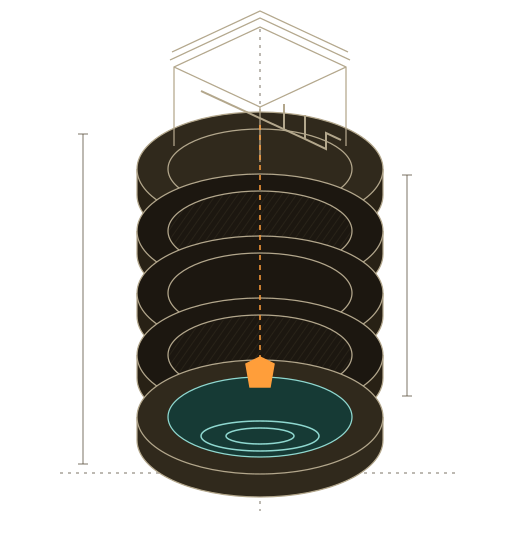
// depth −7 m · sediments of practice
Studnička is Czech for a little well. It took twenty years of enterprise strata to dig — and that is exactly the depth every agent I set loose on production code draws from.
IIS Tábor — Gupta and .NET. The craft begins.
Capgemini, Minerva, RADIUM. Co-owner and team leader at 4Leaders.
Scala, Akka, Play, Kafka, MongoDB. Functional programming, monads, event sourcing. A bank built from scratch.
Scala and Akka Persistence for the energy sector — event sourcing in live production.
Spark, Kafka, HBase, Hadoop, Hive. Integrating the primary systems and DWH of a multinational group.
Java, .NET, Python. Spring Boot, Oracle, Azure Synapse, Spark.
I understood the craft had just changed. I've been doing agentic engineering full-time ever since. Experience carries forward — you reforge it.
“My job is to give agents a clear brief, preserve context and verify that the result holds up in production.”
// depth −18 m · the tool seam
I named my tools after the smithy. Not for the romance — because agentic engineering is a craft: it has a process, tools and quality control. This is my production cycle.
01 · the anvil
issue → spec
Checks the brief against real code. Finds ambiguities and missing context before implementation begins. A human approves changes to the brief.
02 · the forge
issue → pull request
Coordinates agents through implementation, code review, tests and CI. Tracks requirements, manages fixes and verifies the result after merge.
03 · the quench
PR → proof
Tests in a real browser and captures each step. When the interface changes, an agent helps repair the scenario for another repeatable run.
Links requirements to code and tests. Each has its own REQ-ID and verifiable evidence. Gaps between the brief and the result become visible.
Commands and skills for Claude Code and Codex. Repeatable workflows for reviewing and improving security, performance and accessibility.
Turns meeting recordings into GitHub issues in the context of the repository. Includes what was said and what appeared on screen.
…and more: agent-system (orchestration via Telegram), MCP servers, invoiceAI.
Spec-first. An agent without a proper assignment is a random code generator.
Proof, not vibes. I connect every requirement to tests and verifiable evidence.
Human-in-the-loop. AI writes. An engineer stays accountable.
// depth −29 m · load-bearing masonry
software house · co-owner
An agentic software house: AI agents write the code, seniors own architecture, quality and security. Enterprise systems, AI integrations, legacy project rescues.
cognera.cze-commerce · co-owner
nopCommerce experts since 2010. Over 50 e-shops, over 100 custom plugins, B2B and B2C, ERP and CRM integrations.
nopshop.cz// depth −42 m · the waterline
Have a project you want to bring AI agents into? Tell me what you are building, where development gets stuck and what needs to change.